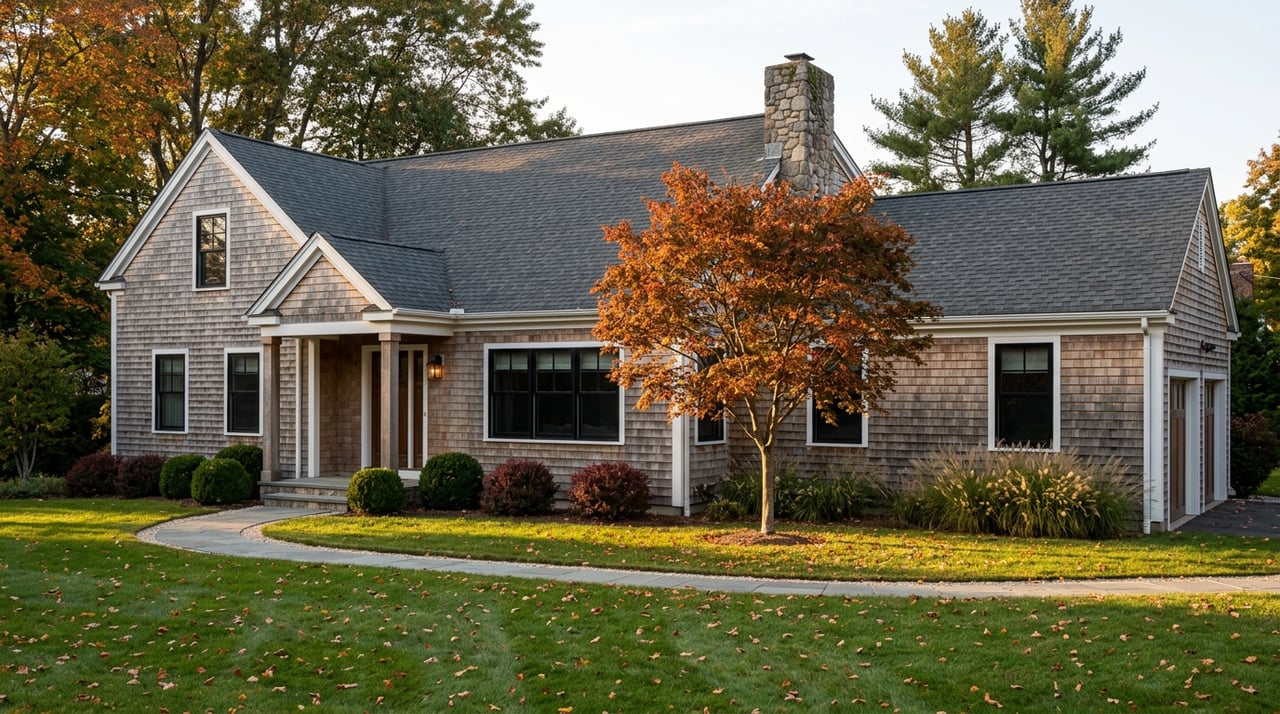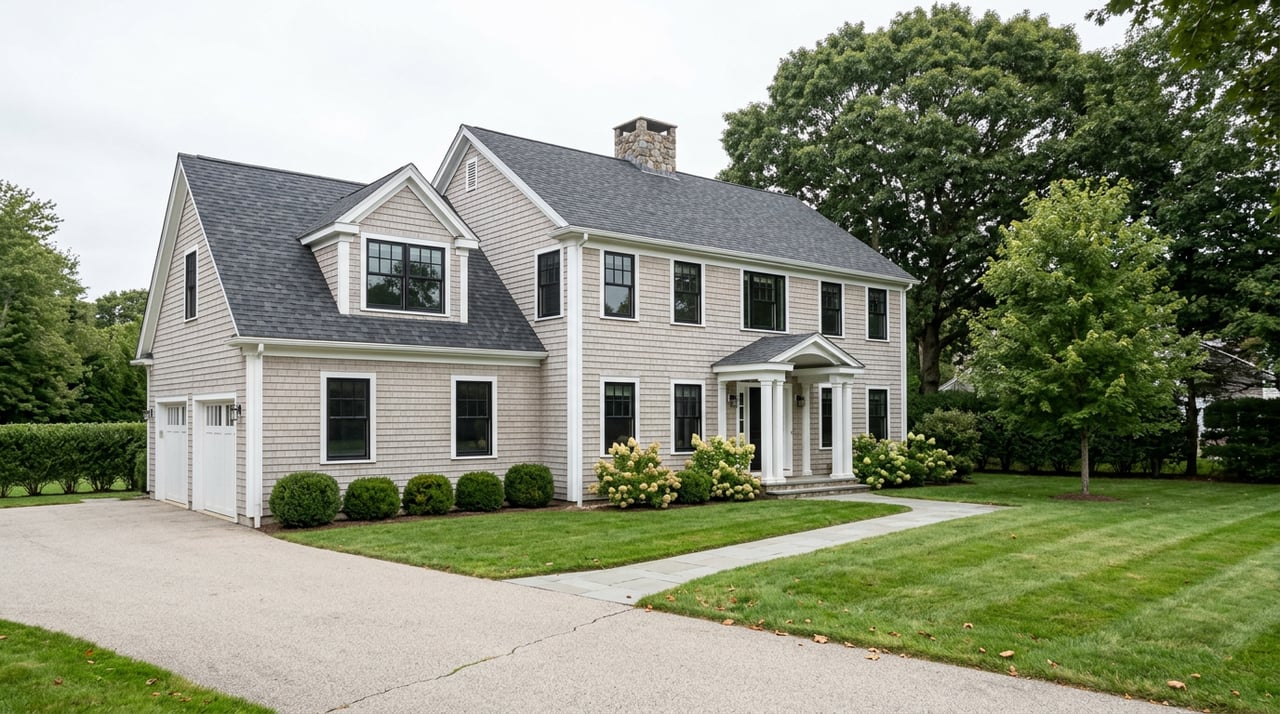
Between July 2013 and June 2023, Needham issued 845 building permits for new single-family houses. In that same ten-year window, the town issued 840 residential demolition permits. Those two numbers sit one apart. Needham's own Large House Review Study Committee, the town body tasked with figuring out what to do about it, ran the math and concluded that roughly 89 percent of new single-family construction in town was replacement housing: a house came down so a bigger one could go up.
That is not a demand story. Every suburb west of Boston has demand. What makes Needham different is a number most buyers never see until they are three offers deep on a house that turns out to be nine years old with the bones of something built in 1958: the town's own zoning lets a builder put more house on a lot here than almost anywhere nearby.
What a 9,000-square-foot lot actually allows
In September 2025, the Large House Review Study Committee put a side-by-side comparison in front of the Planning Board. On a 9,000-square-foot lot in Needham's Single Residence B district, a builder can construct a house measuring roughly 4,900 square feet, garage and finished third floor included. The same lot size in neighboring towns tells a different story.
| Town | Max house size, ~9,000 sq ft lot |
|---|---|
| Needham | ~4,900 sq ft |
| Wellesley | ~3,600 sq ft (design review required above that) |
| Newton | ~3,870 sq ft |
| Lexington | ~3,862 sq ft |
| Concord | ~3,360 sq ft |
That gap is not rounding error. Needham's ceiling runs 20 to 40 percent above its comparable neighbors on the exact same lot size. Committee member Oscar Mertz pointed the Planning Board to Concord's approach as a contrast, telling them the formula there is "one line, super simple," where house size scales directly with lot size rather than hitting a flat cap set decades ago. Needham's version has stayed closer to the flat cap, and a flat cap that sits above everyone else's is, functionally, an invitation.
Builders responded to it. A separate committee analysis tracking teardown-rebuild activity specifically found 392 single-family projects between 2020 and 2024 alone, with 332 of them landing in the Single Residence B district where the size gap is widest. Researchers matched roughly 252 of those against MLS sale records, which means a meaningful share of what is currently listed, or was recently listed, in that part of Needham is a house built under a size formula the town's own committee now says was too generous.
The town said so itself
The Large House Review Study Committee did not dress this up. Its working documents state plainly that the 2017 reforms, the last round of zoning tightening Needham attempted, are not meeting the town's planning goals and need further revision to limit or disincentivize teardowns. That is a striking sentence to read on a municipal website. It is not a critic making the case that Needham's rules favor scale over character. It is the town's own study committee saying the fix it tried nine years ago did not hold.
Compare that to what is happening one town over. Wellesley adopted a 12-month demolition delay bylaw in 2017, and as of a mid-2024 Historical Commission meeting, only 19 of the town's 560 pre-1900 houses had gone through a full delay period since the bylaw took effect. Wellesley's review process is real, but it applies to a narrow slice of the housing stock and stacks on top of a lower size ceiling to begin with. Needham has spent the better part of a decade with a higher ceiling and a lighter process. Builders go where the arithmetic works, and for most of the last ten years, that arithmetic pointed toward Needham.
The rules are changing under this year's listings
None of this is settled history. It is happening on a live meeting calendar right now.
A fiscal impact analysis from RKG Associates, presented to the committee in October 2025, ran the numbers on what tighter dimensional limits would actually cost builders per project. One detail from that presentation stands out: a proposed reduction was projected to cut roughly $20,000 from a typical project's profit margin, a number the committee itself flagged as real but not necessarily project-killing. That is the kind of figure that shapes whether a rule change slows teardown activity or barely dents it.
The first piece of the actual rewrite has already taken effect. A zoning amendment governing how building height is measured at the side yard in the Single Residence B district, designed to keep a roofline from rising straight up before sloping away from a neighbor's lot line, became effective June 1, 2026. The Planning Board spent its July 7, 2026 meeting still working through the harder pieces: front yard setback requirements and how half-story floor area gets counted toward a house's total footprint, the kind of detail that determines whether a shed dormer over a three-car garage counts against the house's allowed size or slides past it.
If you are house hunting in Needham this fall, you are shopping in the gap between the old formula and the new one. A house built or permitted before this year was sized under rules the town has already started tightening. A lot that has not yet been rebuilt may face different limits than the ones that produced the house next door to it.
What the price gap actually tells you
As of May 31, 2026, Zillow's home value index put Needham's average at $1,589,700, up 4.6 percent over the prior year. Wellesley's average on the same date and same index sat at $2,067,574, up 3.6 percent. Redfin's rolling three-month window through May 2026 showed Needham's median sale price at $1.7 million, down 4.7 percent from the same period a year earlier, with 79 homes sold that May against 76 the year before.
Read those numbers side by side and the instinct is to call Needham the value play. That instinct misses what the zoning history actually explains. Needham's price data blends a genuinely wide range of housing stock: original mid-century homes that have never been touched, and a large, recent wave of rebuilds sized under a formula the town itself now considers too permissive. A median or an average across that mix tells you less about what a specific house is worth than it does about how much of the surrounding street has already turned over. Two houses on the same block, one from 1958 and one rebuilt in 2022 under the old formula, can carry very different values for reasons the headline median never separates out.
That is the actual decision in front of a Needham buyer right now. A recent teardown-rebuild carries size and finish that may not be replicable on a comparable lot once the pending setback and floor-area rules land. An untouched older home on a similarly sized lot faces a lower ceiling if its next owner ever wants to rebuild. Neither position is automatically better. Both are worth pricing with the zoning calendar in mind, not just the comps.
A few questions worth asking before you tour
Does a pending zoning change affect a house that is already built? No. Existing structures are not retroactively affected by dimensional rule changes. What changes is what a future owner could build if that house came down, which matters for resale and for anyone eyeing the lot for a rebuild down the road.
How do I find out if a specific Needham lot falls under the districts being revised? The Single Residence B and General Residence districts are the ones under active review. A lot's zoning district is public record through the town, and it is worth confirming before assuming a comparable rebuild elsewhere in town tells you what is buildable on the lot you are actually considering.
Is Needham still adding new construction at the pace it did over the last decade? The building permit and demolition data through 2023 shows the historical pace. Whether that pace holds depends on which of the pending changes the Planning Board and Town Meeting ultimately adopt, which is still an open question as of mid-2026.
Needham's housing stock did not turn over this fast by accident, and it is not finished changing. If you are comparing a rebuild against an original home, or trying to figure out what a lot could still support once the new rules land, that is exactly the kind of question worth working through with someone who tracks it block by block. Rachel Lieberman has been in these Needham conversations long enough to read a zoning timeline the same way she reads a comp sheet. Schedule a strategy call before you make an offer on either side of that gap.